Practical guide for the n8n Community Edition
1. Why a risk‑based approach matters
When a code change lands in a repository the QA team must decide how much testing is required before the change can be released. A deterministic, risk‑based pipeline lets the team:
- Prioritise high‑impact changes with regression suites.
- Save time on low‑risk changes by running only smoke tests.
- Produce immutable evidence (logs, scores, decisions) that can be audited later.
n8n’s visual workflow engine makes it possible to encode this decision logic without writing a custom orchestration service. The following sections walk through a complete, reusable architecture that works entirely within the n8n Community Edition (CE).
2. Architecture Overview
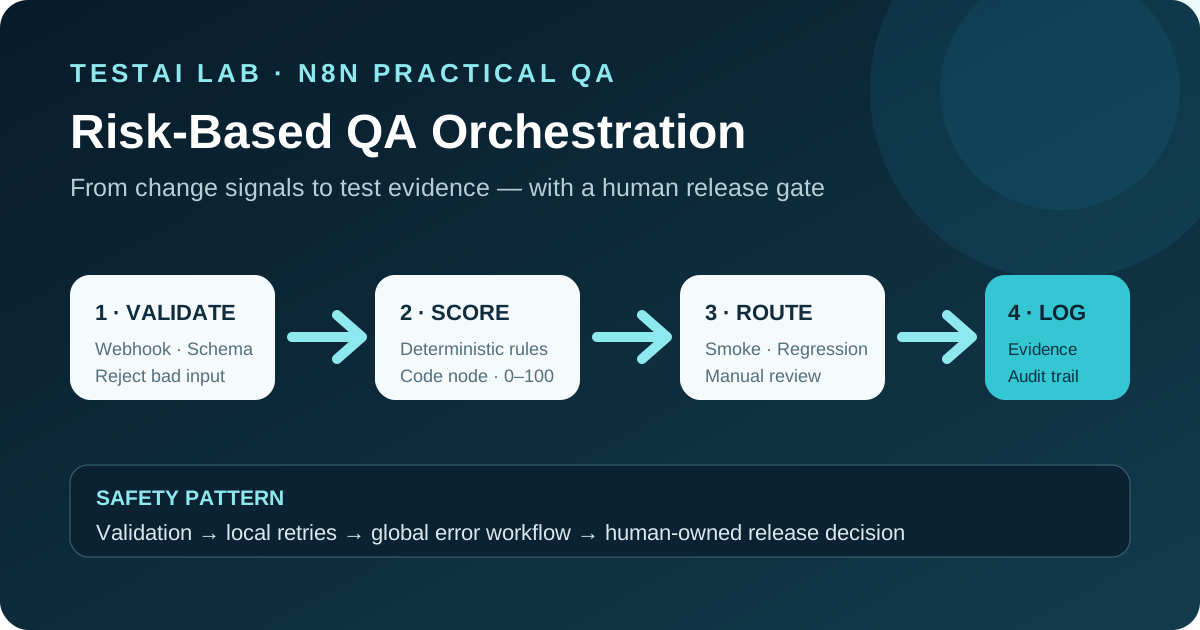
[Validation] → [Risk Scoring] → [Test Route Selection]
      │                │                │
      ▼                ▼                ▼
[Local Error Handling]   →   [Global Error Workflow] → [Evidence Log]
Each block is implemented as a sub‑workflow (called from the main pipeline via the Execute Sub-workflow node). The design keeps the main flow readable, encourages reuse, and isolates error handling.
| Block | Responsibility | Typical n8n nodes |
|---|---|---|
| Validation | Normalise incoming change metadata, reject malformed payloads. | Webhook → Set → IF |
| Risk Scoring | Produce a deterministic numeric score from the normalised data. | Code (JavaScript) |
| Test Route Selection | Map score ranges to a test depth (smoke, regression, manual review). | IF → Execute Sub-workflow (smoke, regression, manual) |
| Local Error Handling | Retry only transient failures; surface permanent errors to the global handler. | Error Trigger → Retry settings on nodes |
| Global Error Workflow | Centralised notification, ticket creation, and correlation‑ID propagation. | Execute Sub-workflow (error handler) |
| Evidence Log | Persist score, selected route, timestamps, and correlation ID for audit. | Data Table or Postgres node |
All sub‑workflows share a correlation ID that travels through the pipeline, making it trivial to trace a change from intake to final evidence.
3. Sub‑workflow 1 – Normalized Change Intake
3.1 Trigger & Input Shape
- Node: Webhook (listening on
/change) - Expected payload (JSON):
{
  "commitId": "a1b2c3d",
  "author": "alice@example.com",
  "changedFiles": ["src/api/user.js", "tests/unit/user.test.js"],
  "labels": ["backend", "critical"]
}
3.2 Validation steps
- Set node creates a flat structure (
commitId,fileCount,hasCriticalLabel). - IF node checks required fields (
commitId&changedFiles). If missing, the workflow throws an error that is caught by the Local Error Handling block.
All validation logic lives in a reusable sub‑workflow called Change Intake – Normalise. It can be called from any pipeline that needs change metadata (e.g., a nightly build monitor).
4. Sub‑workflow 2 – Deterministic Risk Scoring
4.1 Scoring philosophy
The score must be deterministic (same input → same output) and free of external credentials. A simple rule‑based model works well for most teams:
| Rule | Contribution |
|---|---|
fileCount > 20 | +30 |
hasCriticalLabel | +40 |
author in trusted‑list | –20 |
changedFiles contain any *.sql | +20 |
The total is capped at 100 and interpreted later.
4.2 JavaScript Code node (verified syntax)
// Input: items[0].json = { fileCount, hasCriticalLabel, author, changedFiles }
// Output: items[0].json.riskScore (0‑100)

const trusted = ['ci-bot', 'release-bot']; // static list, no credentials

const { fileCount, hasCriticalLabel, author, changedFiles } = items[0].json;

let score = 0;

if (fileCount > 20) score += 30;
if (hasCriticalLabel) score += 40;
if (trusted.includes(author)) score -= 20;
if (changedFiles.some(f => f.endsWith('.sql'))) score += 20;

// Clamp to 0‑100
score = Math.max(0, Math.min(100, score));

items[0].json.riskScore = score;
return items;
No external services, no personal data, and the logic is fully reproducible. The node belongs to the Risk Scoring – Deterministic sub‑workflow.
5. Sub‑workflow 3 – Test Route Selection
5.1 Mapping scores to test depth
| Score range | Route |
|---|---|
| 0‑30 | Smoke only |
| 31‑70 | Full regression |
| 71‑100 | Manual review (human gate) |
5.2 Implementation
- IF node evaluates
riskScore. - Each branch calls an Execute Sub-workflow node that launches the appropriate test suite:
Smoke – lightweight API health checks. Regression – full integration test collection. * Manual Review – sends a Slack message with an Approve/Reject button (no AI decision).
All three test suites are themselves sub‑workflows (Smoke Tests, Regression Suite, Manual Review Gate). They accept the same correlation ID and change metadata, guaranteeing consistent evidence.
6. Sub‑workflow 4 – Local Error Handling
n8n CE allows per‑node retry configuration. The pattern we recommend:
- Transient failures (e.g., network timeouts) → set Retry to
3attempts with exponential back‑off. - Permanent failures (validation errors, missing files) → let the node throw; the error bubbles to the Global Error Workflow.
Configure the Error Workflow on the Workflow Settings page (see the official docs on Error handling in n8n). The local error block also writes a short entry to the evidence log, marking the step that failed.
7. Sub‑workflow 5 – Global Error Workflow
A single, reusable error handler keeps notifications consistent:
- Set node extracts the correlation ID and error message.
- HTTP Request node posts to a monitoring endpoint (e.g., a Teams webhook).
- Create Issue node (GitHub) opens a ticket with the payload for traceability.
Because the error workflow runs outside the main pipeline, it never interferes with the risk scoring or test execution. The correlation ID guarantees that the incident can be linked back to the original change.
8. Sub‑workflow 6 – Evidence Log
Auditable evidence is essential for compliance and post‑mortem analysis. In n8n you can store modest structured evidence directly with the Data Table node (official documentation). For larger retention, use an external database such as Postgres.
Fields to persist:
| Column | Description |
|---|---|
correlation_id | UUID generated at intake |
commit_id | Original commit SHA |
risk_score | Numeric score from the Code node |
test_route | smoke, regression, or manual |
status | passed, failed, error |
timestamp | ISO‑8601 execution time |
The Evidence Log sub‑workflow receives the final status from the test route, writes the row, and returns a summary to the caller. Because the log is written after the test suite finishes, it reflects the true outcome of the change.
9. Cross‑cutting Concerns
9.1 Idempotency & Duplicate Protection
- Use an Edit Fields (Set) node to copy the immutable
commitIdintocorrelation_id; generate a random UUID only once when no stable source identifier exists. - Before executing a test route, an IF node queries the evidence log for an existing entry with the same
commitId. If found, the workflow can skip execution and return the previous result.
9.2 Safe Credential Handling
All credentials (GitHub token, webhook URLs) are stored in n8n’s Credentials store, never hard‑coded. The Credentials UI encrypts values at rest, and the workflow references them by name (e.g., GitHub API). This complies with the official guidance on Credentials security.
9.3 Correlation IDs
An Edit Fields (Set) node creates correlationId once at intake—preferably from the immutable commitId. Every sub-workflow accepts and returns this value unchanged, so logs, errors, and external calls can be joined reliably.
9.4 Structured Inputs / Outputs
All sub‑workflows accept a single JSON object with well‑defined keys (commitId, riskScore, etc.). Using the Merge node with Mode: Append ensures that additional fields (e.g., test artefacts) are added without breaking downstream expectations.
9.5 Human‑Owned Release Gates
The Manual Review branch ends with a Slack (or Microsoft Teams) Message node that includes Approve and Reject buttons. The button click triggers a separate Webhook workflow that records the decision in the evidence log and, if approved, proceeds to a final Deploy sub‑workflow. No AI node is permitted to make the final release decision; the human interaction is the authoritative gate.
10. Where Automation Helps
| Area | Automation benefit | n8n feature |
|---|---|---|
| Change intake | Consistent validation, immediate feedback to developers. | Webhook + Set + IF |
| Risk scoring | Fast, repeatable calculation without manual spreadsheets. | Code node (deterministic JS) |
| Test orchestration | One‑click selection of appropriate suite, no manual script editing. | Execute Sub-workflow + IF |
| Error aggregation | Centralised alerts and ticket creation reduce noise. | Global Error Workflow (HTTP Request, Create Issue) |
| Evidence collection | Immutable audit trail stored automatically. | Data Table or Postgres node |
| Human gate | Guarantees that a person signs off on high‑risk releases. | Slack Message with interactive buttons |
Automation eliminates repetitive plumbing, but the decision points (risk thresholds, manual approval) remain under human control.
11. Expected Results & Failure Paths
| Scenario | Expected outcome | Evidence log entry |
|---|---|---|
| Valid change, low risk | Smoke suite runs, passes, workflow ends with status: passed. | Row with test_route: smoke, risk_score ≤ 30. |
| Valid change, medium risk | Full regression runs; if any test fails, status: failed. | Row with test_route: regression, risk_score 31‑70. |
| Valid change, high risk | Manual review message sent; if rejected, workflow stops with status: error. | Row with test_route: manual, risk_score > 70. |
| Malformed payload | Validation IF node throws; local error handling retries 0 times, then global error workflow creates a ticket. | Row not created; error workflow logs validation_error. |
| Transient network glitch | Node retries up to 3 times; on success the pipeline continues unchanged. | No extra log entry; normal evidence recorded. |
| Duplicate commit processed | Idempotency IF node detects existing evidence and skips test execution. | Row updated with status: duplicate_skipped. |
All paths are deterministic because the same input always follows the same branch logic. The only non‑deterministic element is the human’s button click, which is deliberately left to manual judgement.
12. Review Questions
- What is the purpose of a correlation ID in the risk‑based QA pipeline, and how is it generated in n8n?
- Explain how the deterministic JavaScript Code node calculates a risk score without using external credentials.
- Describe the three test routes and the score ranges that trigger each one.
- How does the global error workflow ensure that transient failures are retried while permanent errors are escalated?
- Why must the final release decision be performed by a human, and how does n8n enforce this in the “Manual Review” branch?
13. Conclusion
By chaining a handful of reusable sub‑workflows—validation, deterministic scoring, route selection, robust error handling, and evidence logging—n8n Community Edition can drive a risk‑based QA orchestration that is transparent, auditable, and fully under human control. The architecture respects the constraints of the CE version (no proprietary nodes, no built‑in AI approval) while still leveraging n8n’s strengths: visual composition, built‑in retry logic, credential safety, and flexible data handling. Teams that adopt this pattern gain a repeatable decision engine that scales from a single microservice to a multi‑repo monolith, all without writing custom orchestration code.
Sources
- n8n Documentation – Error handling: https://docs.n8n.io/flow-logic/error-handling/
- n8n Documentation – Code node (JavaScript): https://docs.n8n.io/integrations/builtin/core-nodes/n8n-nodes-base.code/
- n8n Documentation – Execute Sub-workflow node: https://docs.n8n.io/integrations/builtin/core-nodes/n8n-nodes-base.executeworkflow/
- n8n Documentation – Credentials security: https://docs.n8n.io/credentials/
- n8n Documentation – Data Table node: https://docs.n8n.io/integrations/builtin/core-nodes/n8n-nodes-base.datatable/
(Only official n8n documentation was consulted; no external statistics or unpublished claims are included.)
Leave a comment
Share your thoughts about the article. No account is required.
Comments
Loading comments…