Reusable sub-workflows can make an n8n Community Edition installation easier to understand and maintain. They can also create hidden coupling: a parent workflow may keep running while the called workflow's expected input, output, or failure behavior has changed.
A useful QA approach is to treat every reusable sub-workflow as a contract. The contract describes what the caller sends, what the called workflow returns, which failures are expected, and which side effects must not occur twice. This article separates documented n8n behavior from design recommendations so that the test strategy does not rely on invented platform guarantees.
What n8n documents
n8n uses the Execute Sub-workflow node in a parent workflow and the Execute Sub-workflow Trigger in the called workflow. In the trigger, the input data mode can define fields, use a JSON example, or accept all data. When fields are defined, the calling node can pull those fields into its configuration.
n8n also lets a workflow restrict which other workflows may call it. A sub-workflow containing configuration errors cannot be triggered by its parent. These platform behaviors provide the foundation for an explicit input contract, but n8n does not automatically turn that definition into a complete business schema or a versioned API.
For failures, an error workflow is configured in the workflow settings and must begin with the Error Trigger. The same error workflow may serve multiple workflows. The Error Trigger receives execution and workflow context, although some fields are absent when the failed execution was not saved or when the trigger itself failed.
The Stop And Error node can deliberately fail an execution with an error message or an error object. This is useful when validation finds an invalid request and the workflow must not continue.
During development, n8n supports mocked and pinned data. Mocking creates test input without a live dependency. Pinning reuses saved node output in later manual executions. The documentation explicitly states that pinned data is for development and is not used in production executions.
Webhook nodes expose separate test and production URLs. The production URL becomes available when the workflow is published, while the test URL is used with a listening or manual test session. That separation is important for safe QA: automated development tests should not silently call the production endpoint.
Recommended contract boundary
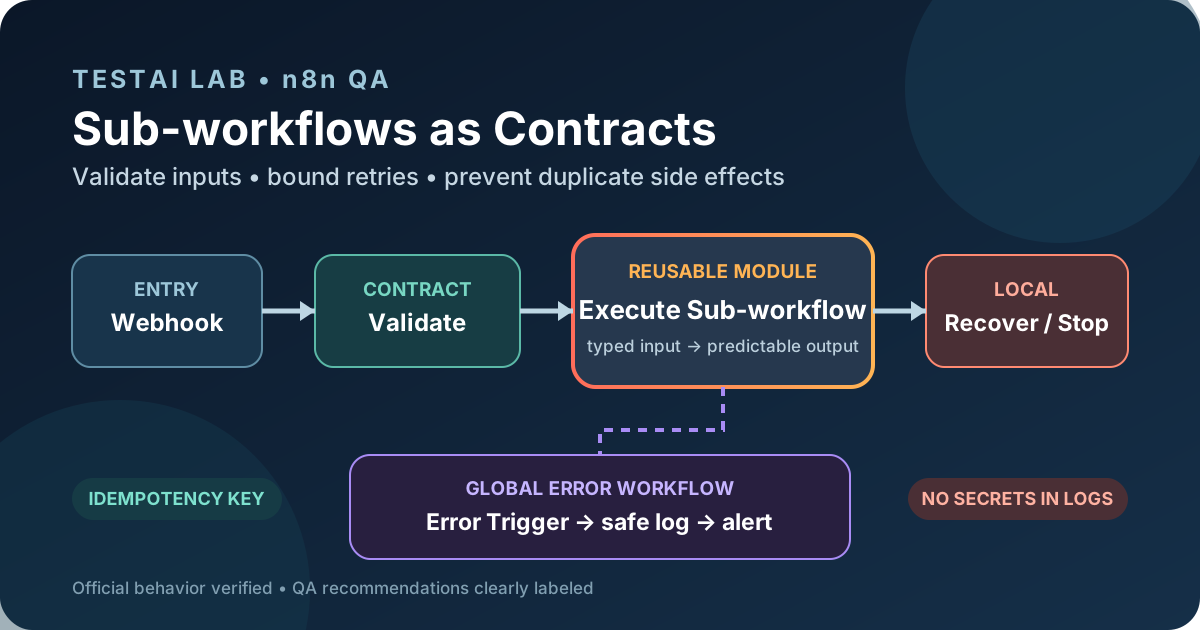
The following architecture is a design recommendation, not a built-in n8n guarantee:
Webhook or parent workflow
  -> Validation sub-workflow
  -> Action sub-workflow
  -> Local failure decision
  -> Global error workflow
The validation component should check data before any irreversible action. The action component should contain the external write, message, or API call. Local handling should classify a failure only when the current workflow has enough context to decide. Unhandled failures should reach the configured global error workflow for consistent logging and notification.
A small contract document can define:
- required input fields, types, formats, and allowed values;
- the output fields that a caller may depend on;
- stable error codes owned by the workflow team;
- whether an operation has side effects;
- the idempotency key and its retention window;
- which failures are considered transient;
- which fields must never appear in logs.
This document is a team artifact. n8n's input definition helps the editor expose expected fields, but deterministic tests must still verify business rules such as maximum length, allowed state transitions, or cross-field dependencies.
Validation before side effects
A validation sub-workflow should be free of external writes whenever practical. It can use If nodes to branch on deterministic conditions and Stop And Error to reject invalid data. An error object can carry a stable team-defined code such as VALIDATION_FAILED, together with a safe message and non-sensitive details.
Test the validation contract with representative fixtures:
- a minimal valid payload;
- each required field missing in turn;
- wrong types and malformed formats;
- empty strings, boundary lengths, and unexpected enum values;
- extra fields that should be ignored or rejected;
- a payload containing HTML or script-like text;
- a payload containing values that must not be written to logs.
For every negative case, assert that the action workflow was not called. A validation test is incomplete if it checks only the error message while allowing the side effect to happen.
Retry only what is safe to repeat
Retry behavior is a node setting, not a universal promise that any failed workflow is safe to replay. A retry should be enabled only for a failure classified as transient and only when repeating the affected operation cannot create duplicate damage.
Examples that may be transient include a network timeout, an HTTP 429 response, or some server-side 5xx responses. A malformed request, an authentication failure, or a business-rule rejection should normally fail without retry.
The retry policy should specify a maximum number of attempts and a delay. Do not describe a single number as universally correct. The correct limit depends on the downstream service, its rate limits, and the cost of repeating the request.
A QA test should verify both boundaries: a transient failure succeeds within the configured attempts, while a persistent failure stops after the configured maximum. It should also verify that validation is not repeated in a way that creates additional external reads or writes.
Idempotency before external writes
Idempotency is an application design responsibility. It is not automatically provided by placing an operation inside a sub-workflow.
Before a side effect, derive or receive a stable idempotency key. If the downstream API supports an idempotency header or key, use the same key for every safe retry of the same logical request. If it does not, store a processed-key record in a suitable durable data store before or together with the business write, according to the consistency guarantees the system needs.
Do not use the Edit Fields node as if it were a persistent key-value database. It shapes items inside an execution; it does not provide durable deduplication across executions.
Useful idempotency tests include:
- sending the same logical request twice;
- retrying after the downstream service accepted the request but the response was lost;
- using different keys for genuinely different requests;
- expiring a key only after the documented retention period;
- running two matching requests concurrently.
The expected result should be explicit. For example, exactly one external record is created and both callers receive the same business identifier, or the duplicate request receives a safe duplicate response.
Local and global error handling
Local handling belongs close to the failing operation when the workflow can make a reliable decision. It may normalize a known response, choose a fallback, or stop with a controlled error object. It must not convert every failure into apparent success.
The global error workflow is appropriate for shared operational behavior such as a sanitized log entry, an alert, or a reference to the failed execution. Its input can differ when the trigger itself fails, so tests should not assume that every field is always present.
Test at least these paths:
- validation failure before the action starts;
- permanent action failure without retry;
- transient action failure recovered within the limit;
- transient action failure after the final attempt;
- failure in the parent workflow after the sub-workflow returns;
- trigger-level failure with reduced error context;
- failure when execution saving is disabled.
The global handler should tolerate missing optional fields and should never fail because it tried to read an absent execution URL.
Logging and credential safety
Logs should contain the minimum information needed to investigate a problem: workflow name, a safe correlation identifier, stage, status, attempt count, error code, and timestamp. Payload bodies, authorization headers, access tokens, passwords, personal data, and credential identifiers should be excluded unless there is a reviewed and lawful need.
Credentials belong in n8n credentials and should be selected by the node that uses them. Do not pass a secret, a credential name, or a temporary token through a normal workflow payload as a substitute for access control. Restrict which workflows may call a sensitive sub-workflow and review who can edit or execute it.
QA should inspect saved execution data and error notifications, not only the happy-path output. A workflow can hide sensitive data from its main response and still leak it through an error object or a debugging message.
Deterministic development tests
Use mocked or pinned data to make manual development checks repeatable and to avoid unnecessary calls to external systems. Pin a representative node output in the editor, then run the downstream logic against success, empty, malformed, and failure-shaped fixtures.
Remember the boundary: pinned data is a development feature and does not apply to production executions. A release test must therefore include a safe staging or dry-run execution that exercises the real node configuration without performing a harmful write.
For a Webhook entry point, test the test URL during development and the production URL only through an explicitly approved smoke test. Verify the HTTP method, authentication choice, path parameters, response status, response body, and behavior when the payload is too large or malformed.
Release-ready QA checklist
Before enabling or changing a reusable sub-workflow, verify:
- the trigger defines fields or a JSON example instead of accepting arbitrary data without validation;
- the caller and callee agree on input names and types;
- outputs used by the parent are present on success;
- error objects contain stable safe codes;
- invalid input reaches Stop And Error before any external write;
- retries are bounded and limited to classified transient failures;
- duplicate requests do not create duplicate side effects;
- the global error workflow handles missing optional context;
- logs and saved executions contain no secrets or unnecessary personal data;
- mocked or pinned fixtures cover positive, negative, and boundary cases;
- test and production Webhook URLs are not confused;
- call restrictions and credential access have been reviewed;
- a safe dry-run or staging test passes;
- rollback and incident steps are documented.
A failure in any safety-critical item should block activation or publication of the workflow change.
Conclusion
Contract testing does not require n8n to behave like a full API management platform. It requires the team to make the boundary observable and testable.
Use documented sub-workflow inputs as the starting point. Add deterministic validation before side effects. Treat Stop And Error as an intentional failure signal. Configure a global error workflow that tolerates incomplete context. Bound retries, design idempotency explicitly, and test duplicate delivery. Use mocked and pinned data for development, while keeping the final release check separate from production writes.
The result is a reusable workflow module whose assumptions are visible, whose failures are classifiable, and whose most expensive risks can be tested before activation.
Sources
- n8n Documentation, “Break workflows into smaller parts”: <https://docs.n8n.io/build/flow-logic/break-workflows-into-smaller-parts/>;
- n8n Documentation, “Handle errors gracefully”: <https://docs.n8n.io/build/flow-logic/handle-errors-gracefully/>;
- n8n Documentation, “Stop And Error”: <https://docs.n8n.io/integrations/builtin/core-nodes/n8n-nodes-base.stopanderror/>;
- n8n Documentation, “Pin and mock data”: <https://docs.n8n.io/build/work-with-data/pin-and-mock-data/>;
- n8n Documentation, “Webhook”: <https://docs.n8n.io/integrations/builtin/core-nodes/n8n-nodes-base.webhook/>;
Leave a comment
Share your thoughts about the article. No account is required.
Comments
Loading comments…