Reliable automation is defined by what happens when input is incomplete, a dependency is unavailable, a request is repeated, or an operator needs enough evidence to understand a failure. In n8n Community Edition, these concerns can be separated into layers so each one has a clear contract and a focused QA strategy.
1. Separate responsibilities
A practical structure is:
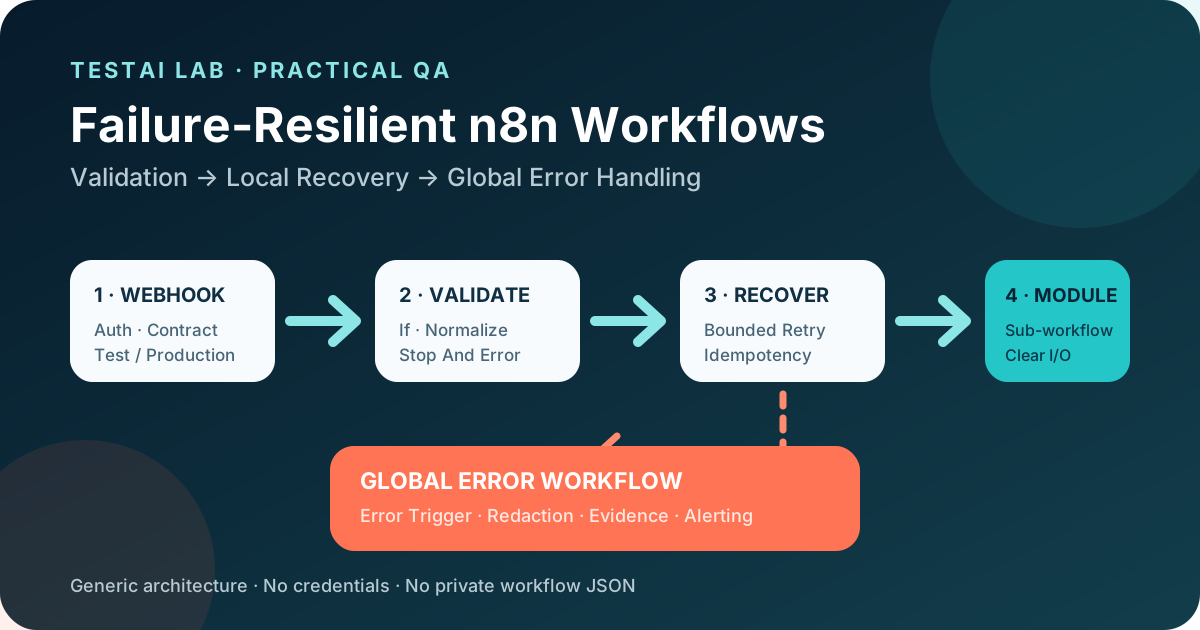
Webhook or trigger → validation and normalization → duplicate or idempotency decision → modular business sub-workflow → local node-level recovery where appropriate → successful result or explicit failure → reusable error workflow for unhandled execution failures
This is an architecture pattern, not an automatic n8n guarantee. n8n provides nodes and execution controls; the workflow author must define the validation rules, persistence, deduplication policy, logging fields, and retry classification.
2. Treat the Webhook as a contract boundary
The Webhook node has separate test and production URLs. The test URL is registered while testing from the editor. The production URL is registered when the workflow is published and is the URL an external caller should use.
The node offers alternative authentication choices, including Basic auth, Header auth, JWT auth, n8n User Auth, or no authentication. It also supports an IP allowlist. Choose the authentication mode required by the integration contract; do not assume that selecting one mode automatically adds another.
QA should verify:
- the external system uses the production URL;
- a valid request starts exactly one expected execution;
- missing or invalid authentication is rejected according to the selected mode;
- an IP outside the configured allowlist is rejected when the allowlist is enabled;
- the response mode and status match the documented API contract;
- sensitive headers and payload fields are not copied into notifications or logs.
The Webhook documentation notes that non-browser requests without a bearer token receive 401 when n8n User Auth is used. Other modes should be tested against their configured behavior rather than assigned a universal status code.
3. Validate before any side effect
Use If, Switch, Filter, and Edit Fields (Set) nodes to make the input contract explicit. A validation failure should stop before a database write, ticket creation, message send, or external API call.
Stop And Error is useful when invalid input must fail the execution deliberately. It can throw either an error message or an error object. A structured object can carry a stable error code, a safe message, and the name of the failed validation rule without exposing the complete incoming payload.
Example error object:
{ "code": "VALIDATION_MISSING_ORDER_ID", "message": "orderId is required", "stage": "input-validation" }
Prepare positive, negative, boundary, wrong-type, empty-string, null, and unexpected-field cases. Confirm not only the final status, but also that no side-effect node executed on a rejected input.
4. Make sub-workflows testable modules
Use Execute Sub-workflow to call reusable logic. A called workflow starts with Execute Sub-workflow Trigger. The trigger can define input fields, which gives the child workflow an explicit interface instead of relying on undocumented payload assumptions.
A useful module has:
- a small, named responsibility;
- documented input fields and output shape;
- no hidden dependence on data from unrelated parent nodes;
- a clear decision about whether the parent waits for completion;
- deterministic behavior for the same input, unless nondeterminism is intentional;
- a separate negative-path test set.
Test the child workflow with representative input, then test the parent-child integration. Verify mapping, item counts, output shape, and failure behavior. Do not assume error propagation: observe it with the actual Execute Sub-workflow configuration used by the workflow.
5. Use local recovery only for transient failures
Node settings include Retry On Fail for supported execution nodes. Configure it only when repeating the operation is safe and the failure can reasonably be transient. The settings expose a number of attempts and a wait between tries; they do not by themselves decide whether a business error is temporary.
Good retry candidates may include a timeout or a temporary service failure. Bad candidates include missing required input, failed authorization caused by a bad secret, an invalid request schema, or a business rule rejection.
Before enabling a retry, answer three questions:
- Can the repeated call create a duplicate side effect?
- Which observed failures are eligible for another attempt?
- What evidence proves how many attempts occurred?
Do not publish a workflow with retries until a test shows both successful recovery and safe behavior when all configured attempts fail.
6. Idempotency and deduplication are design responsibilities
n8n does not make an arbitrary workflow exactly-once. A caller may retry after a timeout, a queue may redeliver an event, or an operator may retry a failed execution.
A common pattern is:
- Receive a caller-provided event or idempotency key.
- Validate the key.
- Check it in a persistent store.
- Reserve or record the key before the protected side effect.
- Return the stored result or a defined duplicate outcome for repeated input.
The correct store and transaction strategy depend on the system. A database uniqueness constraint, atomic cache operation, or application API can be appropriate. An in-memory variable is not sufficient when executions can run concurrently or the instance can restart.
QA must send the same logical request twice and concurrently. The evidence should show one protected side effect, a defined outcome for the duplicate, and no race-induced second write.
7. Add a reusable error workflow
An error workflow is selected in Workflow Settings and must start with Error Trigger. The same error workflow can be assigned to multiple workflows. It receives information about the failed workflow and execution, including the last executed node and error details when available.
Important limitation: n8n states that error workflows cannot be tested by running workflows manually. The Error Trigger runs for automatic workflow errors. Therefore, test it through a safe automatic trigger in a non-production environment or through a dedicated test workflow whose failure has no real side effect.
The error workflow should:
- normalize the error into a stable, minimal schema;
- include a correlation or execution identifier when available;
- redact credentials, tokens, personal data, and unnecessary payload fields;
- route by severity or ownership;
- avoid repeating the failed business side effect;
- record whether notification delivery itself succeeded.
Stop And Error can deliberately fail a main execution and feed a custom error message or object into this path.
8. Preserve useful execution evidence
The execution view is the first place to investigate a failure. Production-grade workflows also benefit from structured business evidence that can be searched independently.
Record only fields needed for support and QA, such as:
- workflow name or stable identifier;
- execution identifier when available;
- safe correlation or event identifier;
- processing stage;
- outcome and stable error code;
- timestamps;
- retry or duplicate decision.
Do not log complete webhook payloads by default. Decide how long successful and failed execution data should be saved, and test the retention configuration. If an external log system is used, test the failure path of the logging call so it cannot hide the original error.
9. Protect credentials and the encryption key
On first launch, n8n creates a random encryption key and saves it in the user folder. Self-hosted deployments may set a custom N8N_ENCRYPTION_KEY. In queue mode, all workers must use the same key.
Keep credentials in n8n credential objects rather than literal node fields or exported example data. Protect the encryption key as a deployment secret, back it up securely, and follow the official rotation procedure instead of simply replacing it.
QA and security review should scan exported workflows, repository files, screenshots, execution samples, and error notifications for tokens, passwords, authorization headers, personal data, and private endpoints.
10. Focused QA matrix
Use these scenarios as a minimum gate:
- Valid request: one execution, expected output, one protected side effect.
- Missing required field: explicit validation error, no side effect, safe error details.
- Wrong data type or boundary value: deterministic rejection or documented normalization.
- Invalid Webhook authentication: request rejected according to the chosen mode.
- Transient dependency failure: configured retry occurs and the final outcome is observable.
- Permanent dependency failure: retries are not misused to hide a deterministic error.
- Duplicate request: exactly one protected side effect across sequential repeats.
- Concurrent duplicate requests: atomic protection prevents a race.
- Child workflow failure: parent behavior matches its actual configuration.
- Automatic execution failure: Error Trigger receives the expected safe context.
- Notification failure: original error remains visible even if alert delivery fails.
- Secret scan: no credentials or sensitive payload data appear in published artifacts.
For every scenario, capture the input class, expected nodes, forbidden nodes, final status, and evidence location.
11. Release checklist
- Confirm the Webhook production URL and authentication contract.
- Run validation cases before any side effect.
- Test every sub-workflow interface independently and through its parent.
- Prove retry safety with an idempotent or protected operation.
- Run sequential and concurrent duplicate tests.
- Trigger the error workflow through an automatic, non-production execution.
- Verify redaction in executions, logs, alerts, screenshots, and exports.
- Confirm credentials and encryption-key handling.
- Save the QA evidence and rollback instructions.
- Re-run high-risk cases after every node, credential, or contract change.
Conclusion
The most reliable n8n workflows are not monolithic canvases with one generic error branch. They have explicit boundaries: authentication at the trigger, validation before side effects, modular sub-workflows, bounded recovery for genuinely transient failures, persistent duplicate protection, and a reusable error workflow for automatic execution failures.
That structure gives QA observable contracts. It becomes possible to prove what ran, what did not run, what was retried, what was rejected, and whether a failure remained safe. Resilience is therefore not a single node; it is an architecture plus repeatable evidence.
Leave a comment
Share your thoughts about the article. No account is required.
Comments
Loading comments…