How explicit permissions, review boundaries, and failure‑containment mechanisms turn what looks like friction into concrete test oracles and risk controls.
1. Why “constraints” are now a testing topic
The conversation around autonomous AI systems has been dominated by speed, scale and interoperability. At recent European gatherings such as AGNTCon and MCPCon, speakers highlighted the need to push volumes of AI‑generated code, decisions and actions ever higher. At the same time, Keith Klain warned that governance is often treated as a “soft” constraint that should be minimized.
Two facts emerged from those discussions:
- Human‑review capacity is limited. The rate at which AI agents can produce artefacts far outpaces the bandwidth of engineers who can read, understand and approve each output.
- Systemic risk can arise from many individually defensible choices. When each decision stays within a narrow safety envelope, the combination of those decisions can still produce a failure that no single checkpoint would have caught.
For a QA team, those observations translate into a simple, test‑centric truth: without clear, enforceable constraints an AI agent is effectively a black box. The black box can be observed, but it cannot be reliably exercised, measured or held accountable.
2. From governance to testability
2.1 Governance as an observable boundary
In traditional software, a test oracle is often a specification, a contract, or a set of business rules that define the expected outcome. With an autonomous agent, the “specification” lives not only in the code but also in the operational constraints that the system is allowed to cross. When a constraint is explicit—for example, “the agent may spend no more than $10,000 per transaction” or “the agent must request human approval for any data deletion”—the constraint itself becomes a testable invariant.
Source fact: Klain highlighted human oversight as an “assurance boundary” that can stop a cascade of decisions before they become harmful. By codifying that boundary (e.g., a mandatory review step), the boundary can be verified in the same way a functional requirement is verified.
2.2 Permissions and capability caps
Permissions define what an agent may do, while capability caps define how much it may do it. In practice these are often expressed as:
| Constraint type | Example | Testable condition |
|---|---|---|
| Action whitelist | Agent can only invoke createTicket, updateTicket, closeTicket | Verify that every API call belongs to the whitelist |
| Resource quota | Max 5 GB of storage per user session | Assert that usage counters never exceed the quota |
| Time‑window | Only operate between 08:00‑18:00 UTC | Check timestamps on each action |
| Risk score threshold | Autonomy score must stay ≥ 0.15 (circuit‑breaker) | Simulate edge cases that push the score below the floor and confirm the agent drops to supervised mode |
These constraints are observable at runtime, making them natural checkpoints for both manual exploratory testing and automated regression suites.
2.3 Review checkpoints as test oracles
A review checkpoint is a moment where the system hands control to a human. In a test plan, the checkpoint can be treated as a validation point:
- “Did the agent pause and present a decision summary before proceeding?”
- “Was the summary logged in a way that auditors can trace it later?”
If the checkpoint is missing, the test fails. If it is present but the information is incomplete, the test also fails. The checkpoint therefore serves as a binary oracle (pass/fail) that does not require deep semantic analysis of the agent’s internal reasoning.
3. Designing test artefacts around constraints
3.1 Mapping constraints to test cases
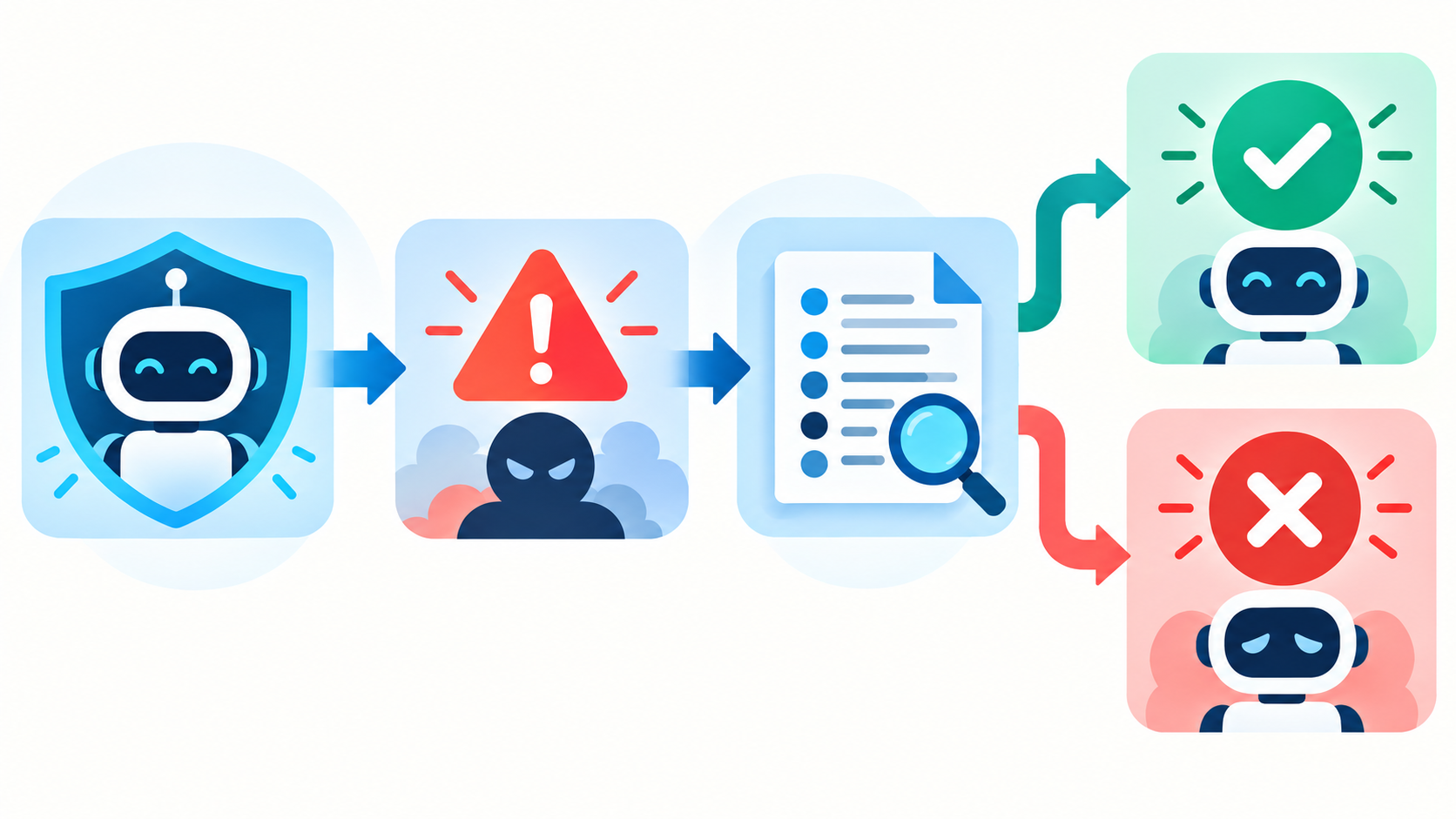
- Identify the constraint catalogue – Gather all explicit permissions, quotas, and escalation rules from design documents, policy files, or the agent’s contract layer.
- Create a constraint‑matrix – List each constraint, the associated risk (e.g., financial loss, data breach), and the required evidence (log entry, audit record, UI prompt).
- Derive test scenarios – For each row, write at least one positive scenario (the constraint is respected) and one negative scenario (the constraint is deliberately violated).
Example:
- Constraint: “Agent may not delete customer records without a supervisor’s digital signature.”
- Positive test: Agent attempts deletion, UI prompts for signature, supervisor signs, deletion succeeds, audit log records the signature.
- Negative test: Agent attempts deletion, UI does not request signature, deletion proceeds – test fails because the audit log shows an unauthorized deletion.
3.2 Exploratory testing with “failure‑containment” lenses
When an agent is deployed in a production‑like sandbox, exploratory testers can adopt a failure‑containment mindset:
- “What happens if the agent exhausts its budget?” – Does it stop, degrade, or request more funds?
- “If the autonomy score drops below the circuit‑breaker threshold, does the agent automatically switch to a supervised mode?” – Verify the mode switch and the visibility of the transition.
These questions focus on systemic behaviours rather than isolated input‑output pairs, aligning with the observation that “complex‑system failures can emerge from many individually defensible decisions.”
3.3 Human‑in‑the‑loop validation
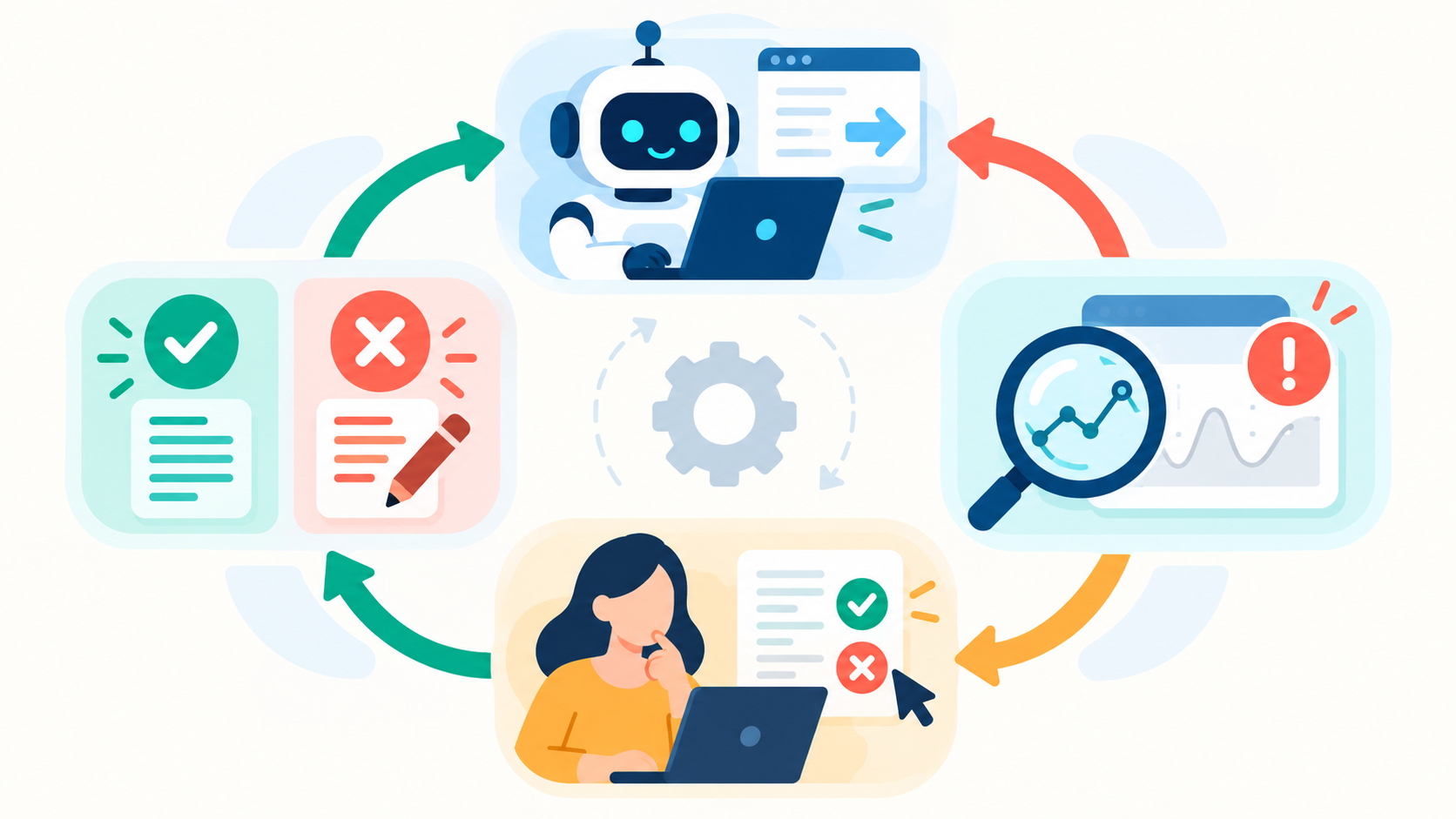
Even the most sophisticated automated checks cannot replace a human’s judgment about appropriateness of a decision. A practical approach is to embed shadow runs:
- Deploy a new version of the agent alongside the production version.
- Feed the same live inputs to both agents.
- Capture the divergent actions and present them to a reviewer.
The reviewer’s verdict becomes part of the test evidence, and the shadow‑run framework itself is a testable artefact (e.g., “no more than 2 % of decisions should diverge without a documented rationale”).
4. Concrete examples
4.1 AI‑generated code assistant
A code‑generation agent is allowed to create new functions but must never modify existing production files without a pull‑request that receives at least one human approval.
Test design:
- Positive – Prompt the agent to write a new utility function; verify that a PR is opened, contains only new files, and passes the “approval required” gate.
- Negative – Prompt the agent to “refactor the authentication module”; verify that the agent either refuses or creates a PR that is flagged for manual review because it touches protected files.
4.2 Autonomous financial‑transaction agent
In a banking prototype, the agent can approve transactions up to $5,000 automatically. Anything larger must trigger a risk‑score evaluation and, if the score falls below 0.2, the transaction is routed to a compliance officer.
Test design:
- Simulate a series of $4,999 transactions – confirm they are auto‑approved and logged.
- Simulate a $7,500 transaction with a low risk score – confirm the system pauses, displays the risk details, and requires manual sign‑off before proceeding.
4.3 Customer‑service chatbot with tool use
A chatbot can invoke a “schedule‑appointment” tool but must never expose personal health information to third‑party services.
Test design:
- Ask the bot to schedule a medical check‑up; verify that the tool is called with only a reference ID, not the full health record.
- Attempt to extract the health record via a crafted prompt; confirm the bot refuses and logs the attempt.
These examples illustrate how a constraint‑first mindset turns policy language into concrete test steps that can be executed manually, automated, or both.
5. Five questions every tester should ask when evaluating an AI agent
| # | Question | Why it matters |
|---|---|---|
| 1 | What explicit permissions does the agent have, and where are they enforced? | Determines the surface you can safely test and the failure modes you must watch for. |
| 2 | Which actions trigger a human‑review checkpoint, and how is that checkpoint recorded? | Verifies that the assurance boundary is observable and auditable. |
| 3 | What quantitative caps (budget, time, risk score) are applied, and what happens when they are exceeded? | Checks the agent’s built‑in containment mechanisms (circuit‑breakers, degradation). |
| 4 | How does the system surface its internal state (e.g., autonomy score, tool selection) to a tester or auditor? | Enables observability, which is a prerequisite for any meaningful manual or automated test. |
| 5 | What fallback behavior is defined if a constraint cannot be satisfied (e.g., escalation, safe‑shutdown, degradation)? | Ensures that the system fails gracefully rather than silently violating a policy. |
Answering these questions early in a test plan helps the team decide where manual probing is essential and where automated checks can safely take over.
6. Where automation helps
Automation is not the enemy of constraint‑driven testing; it is the enabler that lets humans focus on judgment‑heavy tasks.
| Automation focus | Typical tool / technique | Value added |
|---|---|---|
| Constraint‑violation detection | Runtime policy engines, eBPF monitors, or custom middleware that intercepts API calls | Instantly flags any action outside the whitelist, reducing manual log‑scrutiny. |
| Metric collection | Observability platforms (OpenTelemetry, Prometheus) that emit autonomy scores, budget usage, and checkpoint timestamps | Provides the data needed for the “risk‑score threshold” and “budget cap” tests. |
| Regression of guard‑rail logic | CI pipelines that run a suite of positive/negative constraint scenarios on every build | Guarantees that a new code change does not unintentionally relax a policy. |
| Shadow‑run orchestration | Feature‑flag frameworks that route live traffic to parallel agent versions | Automates the “dual‑run” comparison, leaving only the final human decision to a reviewer. |
| Synthetic‑environment simulation | Containerised sandboxes that emulate production services with controllable failure modes | Allows testers to provoke edge‑case behaviours (e.g., quota exhaustion) safely. |
By automating the observable parts of a constraint—detecting violations, gathering metrics, and replaying scenarios—testing teams free up mental bandwidth for the interpretive parts: assessing whether a human‑review checkpoint presented the right context, or whether a fallback action aligns with business intent.
7. Conclusion
The rush to deploy ever more capable AI agents must be balanced with explicit, enforceable constraints. Those constraints are not bureaucratic friction; they are testable contracts that turn a black‑box agent into a system whose safety, compliance, and reliability can be demonstrated.
For QA professionals, the practical workflow looks like this:
- Catalog every permission, quota, and escalation rule.
- Translate each rule into a testable oracle (pass/fail, metric threshold, audit record).
- Design both positive and negative scenarios that exercise the rule.
- Run automated checks for the low‑level invariants, while using manual or exploratory testing to evaluate the human‑oversight loops and fallback behaviours.
- Iterate as new constraints emerge—treat each addition as a fresh test surface rather than a roadblock.
When constraints are treated as first‑class citizens in the test strategy, they become the very mechanisms that give QA teams confidence that autonomous agents will act within the boundaries the organization has set. In that sense, constraints are the enablers of trustworthy AI, not the obstacles to its adoption.
Sources
- Klain, K. “The Flurry of Constraints.” Quality Remarks. https://qualityremarks.com/the-flurry-of-constraints/?utm_source=rss&utm_medium=rss&utm_campaign=the-flurry-of-constraints
- “QA Trends for 2026: AI, Agents, and the Future of Testing.” Tricentis Blog. http://tricentis.com/blog/qa-trends-ai-agentic-testing
- “AI Guardrails Create New Testing Challenges.” QA Financial. https://qa-financial.com/agentic-ai-guardrails-create-new-testing-challenges-for-banks-digital-systems
- “What is Agentic AI Testing?” Airbyte. https://airbyte.io/agentic-data/agentic-ai-testing
- “Agent Autonomy with Governance Constraints: Escalation Tiers.” Agility at Scale. https://agility-at-scale.com/ai/agents/agent-autonomy-with-governance-constraints
Leave a comment
Share your thoughts about the article. No account is required.
Comments
Loading comments…