Target audience: QA engineers, test automation engineers, and software teams that ship AI‑augmented features.
1. Why a Risk‑Based Approach Is Essential for AI
Traditional regression testing assumes that a function’s output is deterministic: given the same inputs, the same result is expected. Generative AI, retrieval‑augmented models, and large language models (LLMs) break that assumption. Their outputs are probabilistic and can shift with subtle changes to the model, prompt wording, retrieval corpus, or system instructions.
The NIST AI Risk Management Framework (AI RMF) organizes risk management around four functions: Govern, Map, Measure, and Manage. It describes trustworthy AI characteristics such as validity and reliability, safety, security and resilience, accountability and transparency, explainability, privacy enhancement, and harmful-bias management. This article turns those principles into a project-specific regression strategy; NIST does not prescribe the concrete test matrix or numeric thresholds used in the examples.
A risk‑based regression strategy focuses testing effort on the areas where a change is most likely to break a contract or introduce an unsafe behavior, rather than re‑running an exhaustive suite that treats every output as a hard oracle.
2. Building a Risk‑Based Regression Matrix
The matrix maps change categories to risk buckets and to the type of evidence required before a release can proceed. It also clarifies where each test lives in the CI/CD pipeline (pull‑request, nightly, pre‑release).
| Change Category | Affected Risks | Evidence Required | CI Stage |
|---|---|---|---|
| Model version bump | • Output drift<br>• Safety‑guardrail regression<br>• Performance regression | • Baseline comparison on golden dataset (score thresholds)<br>• Drift monitoring metrics (e.g., KL‑divergence)<br>• Metamorphic invariants | Nightly + Pre‑release |
| Prompt / system‑instruction tweak | • Prompt injection, hallucination increase<br>• Contract violation (e.g., format change) | • Invariant/contract tests on a representative prompt set<br>• Adversarial prompt suite | Pull‑request (fast) |
| Retrieval corpus update | • Knowledge‑base inconsistency<br>• Privacy leakage | • Seeded replay of retrieval queries<br>• Permission‑boundary checks on returned documents | Nightly |
| Permission / tool‑access change | • Unauthorized tool usage<br>• Escalation of privilege | • Permission‑boundary unit tests<br>• Role‑based access simulations | Pull‑request |
| Deterministic business rule change (e.g., pricing calculation) | • Financial mis‑calculation<br>• Regulatory non‑compliance | • Golden‑dataset assertions (exact match)<br>• Contract tests on API payloads | Pull‑request |
| Safety guardrail update (e.g., profanity filter) | • Harmful content leakage<br>• Policy violation | • Guardrail regression suite (negative tests)<br>• Human‑review sampling | Pre‑release |
| UI / API integration change | • Broken contracts, missing fields, latency spikes | • Schema validation (OpenAPI contract)<br>• End‑to‑end UI flow with Playwright | Pull‑request + Nightly |
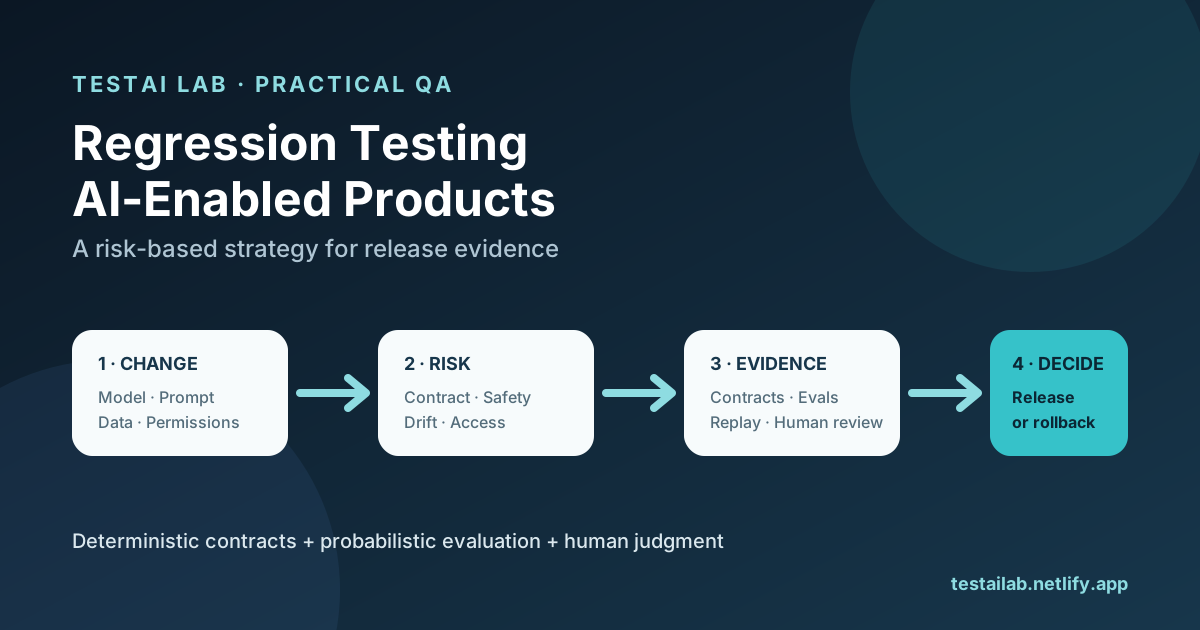
> Pattern used throughout the guide: > Change → Affected Risks → Evidence → Release Decision
3. Test Types and How They Fit the Matrix
| Test Type | What It Verifies | Deterministic vs. Probabilistic | Where to Run |
|---|---|---|---|
| Golden‑dataset (exact‑match) assertions | Fixed‑output contracts (e.g., “convert USD to EUR”) | Deterministic | Pull‑request |
| Invariant / contract tests | API schema, required fields, response shape | Deterministic | Pull‑request |
| Metamorphic tests | Relationship between inputs and outputs (e.g., swapping synonyms should not change sentiment polarity) | Probabilistic (tolerances) | Nightly |
| Adversarial prompt checks | Model’s resistance to injection or jailbreak attempts | Probabilistic (pass/fail based on safety thresholds) | Pull‑request |
| Permission‑boundary checks | Enforcement of role‑based tool access | Deterministic (allowed/denied) | Pull‑request |
| Seeded replay of retrieval queries | Consistency of retrieved documents after corpus change | Deterministic for IDs, probabilistic for ranking | Nightly |
| Baseline comparison with score thresholds | Overall quality drift (BLEU, ROUGE, or custom relevance score) | Probabilistic (thresholds) | Nightly + Pre‑release |
| Drift monitoring dashboards | Continuous statistical monitoring of model output distributions | Probabilistic | Ongoing (post‑release) |
| Rollback gate | Automated block if drift exceeds pre‑defined limits | Probabilistic (gate condition) | Pre‑release |
| Human‑review sampling | Qualitative assessment of edge cases, safety guardrails | Human‑in‑the‑loop (subjective) | Pre‑release |
3.1 Compact Example: Prompt Change
Change: The system instruction is altered from “Answer concisely” to “Answer concisely, limit to two sentences.”
Affected Risks:
- Potential for truncation of essential information (contract breach).
- Increased chance of ambiguous phrasing that could be misinterpreted.
Evidence:
- Run a contract test on a set of 20 critical prompts; assert that required fields (e.g.,
answer.summary) are present and length ≤ 2 sentences. - Execute an adversarial prompt that tries to force the model to exceed the limit; verify that the guardrail blocks or truncates.
Release Decision: If all contract tests pass and no guardrail violations are observed, the PR can be merged. If any prompt produces a missing field, the change is rejected and the team revisits the instruction wording.
3.2 Compact Example: Model Version Upgrade
Change: Upgrade from model‑v1.2 to model‑v1.3.
Affected Risks:
- Output drift on core use‑cases (e.g., summarization).
- Regression of safety guardrails (new toxic language patterns).
Evidence:
- Golden dataset of 500 summarization inputs; compute ROUGE‑L scores against a reference. Require ≥ 0.85 average.
- Safety guardrail suite with 100 known toxic prompts; ensure ≤ 1% pass rate.
- Drift metrics (e.g., KL‑divergence of token distributions) must stay below 0.02.
Release Decision: If any metric falls outside thresholds, the upgrade is blocked and a rollback gate triggers. The team may need to fine‑tune or adjust guardrails before proceeding.
4. Organising Test Execution in CI/CD
| Pipeline Stage | Typical Test Set | Rationale |
|---|---|---|
| Pull‑request (fast feedback) | • Contract & schema tests<br>• Permission‑boundary unit tests<br>• Small adversarial prompt suite<br>• UI smoke with Playwright (critical flows) | Quick to run, catches regressions that would break the build. |
| Nightly (full regression) | • Metamorphic & invariance suites<br>• Golden‑dataset baseline comparisons<br>• Retrieval replay<br>• Drift calculations<br>• Full UI end‑to‑end suite | Allows longer‑running, data‑intensive tests without blocking developers. |
| Pre‑release (gate before production) | • Full safety‑guardrail regression<br>• Score‑threshold checks on latest model<br>• Rollback gate evaluation<br>• Human‑review sampling (e.g., 0.5 % of production traffic) | Provides final assurance that the release meets risk tolerances. |
Implementation tip: Use GitHub Actions to gate merges on the PR suite (actions/checkout, actions/setup-python, etc.) and to trigger nightly workflows on a schedule
Playwright can be integrated via the official Microsoft docs for UI testing Learn‑Microsoft‑Playwright.
5. Distinguishing Deterministic Assertions from Probabilistic Evaluations
| Aspect | Deterministic | Probabilistic |
|---|---|---|
| Nature of oracle | Exact value or presence (e.g., JSON field status: "OK"). | Statistical or tolerance‑based (e.g., average BLEU ≥ 0.78). |
| Failure mode | Binary – pass/fail. | May require threshold tuning; occasional “false‑negative” drift is acceptable if within limits. |
| Typical test | Schema validation, permission checks, golden‑dataset exact match. | Metamorphic relations, score thresholds, drift metrics. |
| Human involvement | Usually none. | Often a review of outliers or trend analysis. |
When documenting a test, always state whether the assertion is deterministic or probabilistic, and include the tolerance or threshold that defines a pass.
6. “Change → Affected Risks → Evidence → Release Decision” in Practice
Below is a concise checklist that QA leads can embed into release notes.
| Change | Affected Risks | Evidence Collected | Decision |
|---|---|---|---|
| New tool integration (e.g., code‑generation plugin) | Unauthorized execution, data exfiltration | Permission‑boundary unit tests (all denied for non‑admin role) + security‑guardrail negative tests (no code emitted for disallowed domains) | ✅ Merge; monitor post‑release logs |
| Prompt template overhaul | Inconsistent tone, missing citations | Contract tests on 30 key prompts (citation field present) + metamorphic test (reordering bullet points does not change citation count) | ⚠️ Fail – revise template to preserve citation logic |
| Retrieval corpus refresh | Stale knowledge, privacy leakage | Seeded replay of 100 known queries (IDs match) + privacy check (no PII in top‑5 results) | ✅ Promote to pre‑release; schedule next nightly audit |
| Safety guardrail rule tightening | Over‑blocking legitimate requests | Guardrail regression suite (≤ 2 % false‑positive on benign prompts) + human‑review of 20 sampled blocked responses | ✅ Release with rollback gate set at 5 % false‑positive increase |
7. Where Automation Helps
- Fast deterministic checks – schema validation, permission enforcement, and exact‑match golden datasets are ideal for PR‑level automation.
- Statistical drift monitoring – automated calculation of KL‑divergence, BLEU, or custom relevance scores can run nightly and feed dashboards.
- Metamorphic test generation – tools can programmatically create input variations (e.g., synonym swaps) to exercise probabilistic invariants.
- Adversarial prompt fuzzing – CI can inject a curated list of jailbreak attempts and verify that safety filters trigger.
- Rollback gating – CI pipelines can automatically halt promotion if drift metrics exceed thresholds, reducing human toil.
Automation does not replace human judgment for safety‑critical or policy‑driven outputs. Human review remains essential for evaluating nuanced harms, bias, or regulatory compliance.
8. Practical Steps to Get Started
- Identify contracts – List all deterministic outputs (API schemas, UI elements, business‑rule calculations).
- Define risk buckets – Map each contract to the change categories that could affect it (model, prompt, data, permissions).
- Select evidence types – Choose deterministic assertions for contracts and probabilistic thresholds for quality/safety.
- Create the regression matrix – Populate the table in Section 2; store it in a version‑controlled document.
- Implement CI hooks – Use GitHub Actions or your CI platform to run the appropriate suite at each pipeline stage.
- Set thresholds & gates – Define project-specific score thresholds from documented risk tolerance and baseline evidence. For example, a team may allow no more than a 0.5% increase in harmful-content failures; this number is an illustrative project rule, not a NIST recommendation.
- Add human‑review checkpoints – Define sampling size and criteria for pre‑release manual evaluation.
- Iterate – After each release, review drift logs and incident reports; adjust the matrix, thresholds, or test coverage accordingly.
9. Review Questions
- What distinguishes a deterministic regression test from a probabilistic one, and why is this distinction important for AI‑enabled products?
- How does the “change → affected risks → evidence → release decision” pattern help QA teams prioritize testing effort?
- Name three test types that are best suited for pull‑request validation and explain why.
- What metrics can be used in a nightly drift‑monitoring suite to detect undesirable changes after a model upgrade?
- Why is a human‑review sampling step required even when automated safety‑guardrail tests pass?
10. Conclusion
Regression testing for AI‑enabled systems cannot rely on a single “golden answer.” By classifying changes, mapping them to concrete risks, and collecting the right mix of deterministic and probabilistic evidence, teams can make informed release decisions while keeping safety, compliance, and quality under control. Embedding this risk‑based matrix into the CI/CD workflow—pull‑request checks for fast deterministic contracts, nightly suites for statistical drift, and pre‑release gates for safety guardrails—provides a scalable, repeatable process that aligns with the NIST AI Risk Management Framework and industry best practices.
Sources
- NIST AI Risk Management Framework 1.0 — Govern, Map, Measure, and Manage functions and trustworthy-AI characteristics. https://www.nist.gov/itl/ai-risk-management-framework
- OWASP Top 10 for LLM and Generative AI Applications — security risks including prompt injection. https://genai.owasp.org/
- GitHub Actions documentation — event-driven, manual, and scheduled workflow execution. https://docs.github.com/en/actions
- Playwright documentation — official CI guidance and GitHub Actions examples. https://playwright.dev/docs/ci
Leave a comment
Share your thoughts about the article. No account is required.
Comments
Loading comments…