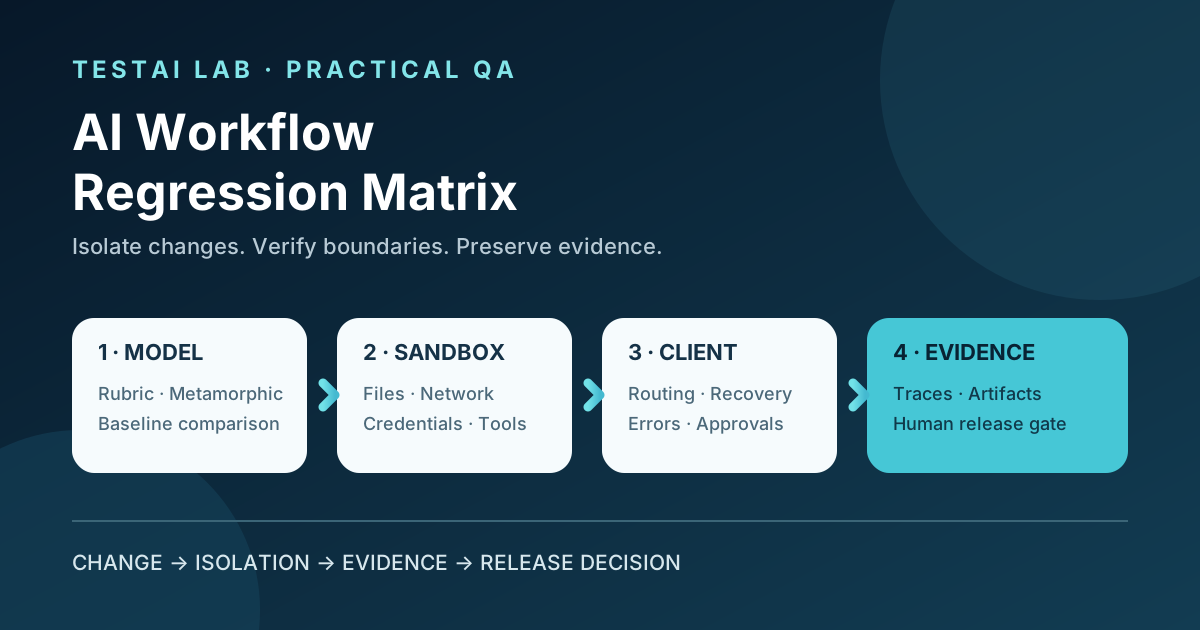
An AI coding workflow can change in several places at once: the selected model, local sandbox policy, telemetry configuration, or the client that starts the task. A single failure such as “the agent could not finish” does not identify which layer regressed.
GitHub’s September 21 Copilot release bundle is a useful example. It announced additional models, local sandboxing in public preview, OpenTelemetry configuration, and updates across Slack, Microsoft Teams, JetBrains, and VS Code. Those are product facts. The test design below is our QA proposal; it is not a description of tests performed by GitHub.
1. Define the system as four testable layers
Treat the workflow as four connected layers:
- Model layer: produces probabilistic code or explanations.
- Policy layer: decides whether file, network, credential, or tool access is allowed.
- Client layer: sends context, shows progress, requests approvals, and presents errors.
- Evidence layer: records enough telemetry and artifacts to explain what happened.
The key testing question is not only “Did the task pass?” It is “Which layer changed, what evidence proves the result, and can we reproduce it?”
2. Build a baseline before changing anything
Use a small fixed task set that represents real work without touching production data. For example:
- modify one function in a disposable repository;
- run a local unit test;
- read a file that is inside the permitted workspace;
- attempt to read a synthetic file outside the permitted workspace;
- call an approved mock HTTP endpoint;
- attempt to call a blocked mock host;
- request an operation that needs explicit human approval.
Run the set on the current stable configuration and save the selected model, client version, sandbox policy, test repository commit, prompts, tool decisions, generated patch, test output, and final status.
Do not use an exact generated answer as the baseline. GitHub documents that Copilot supports multiple models with different strengths and that model availability can change. Generated content is probabilistic; the stable oracle should be observable behavior and acceptance criteria.
3. Separate deterministic contracts from probabilistic quality
Deterministic checks answer questions with a clear yes or no:
- Did the response contain the required structured fields?
- Was a denied filesystem path left unchanged?
- Did the mock server receive zero requests when its host was blocked?
- Was an approval required before a protected action?
- Did the client display a usable error instead of remaining in Loading?
- Were test artifacts linked to the correct run?
Probabilistic checks evaluate the quality of the proposed change:
- Does the patch satisfy the task?
- Do existing tests still pass?
- Did the model introduce unnecessary changes?
- Is the explanation technically correct?
- Is the solution maintainable and safe?
Score probabilistic results with a human-owned rubric. Example dimensions are correctness, scope control, test evidence, security, and maintainability. Any numeric threshold must come from the project’s own baseline and risk tolerance; it is not a GitHub requirement.
4. Use a change-isolation matrix
Run the same task set in controlled combinations:
- baseline model + baseline policy + baseline client;
- candidate model + baseline policy + baseline client;
- baseline model + candidate policy + baseline client;
- baseline model + baseline policy + candidate client;
- candidate model + candidate policy + candidate client.
Change only one dimension in the middle runs. This creates evidence for triage.
If quality scores fall only with the candidate model, investigate model behavior and prompts. If an allowed tool starts failing only under the candidate policy, inspect sandbox rules. If the same request succeeds through one client but loses context or approvals through another, treat it as an integration defect. If all combinations fail, check shared services and test data before blaming any candidate component.
5. Test sandbox boundaries through side effects
Local sandboxing is intended to restrict filesystem access, network connectivity, and credential use. Test the policy through observable side effects in a disposable workspace.
For an allowed write, verify the exact file path, content, and diff. For a denied write, verify that the target does not exist and that no neighboring file changed. For network tests, use local mock endpoints and confirm allowed or blocked requests in mock logs. For credentials, use synthetic tokens only and assert that secrets are unavailable where policy says they should be masked.
Settings are configured separately across supported surfaces, and operating-system behavior can differ. Record the client, operating system, and effective policy with every result. Never infer that a policy verified in one surface automatically applies to every other client.
6. Check client integration without assuming identical features
The release bundle mentioned several clients, but that does not mean each client exposes the same sandbox or telemetry behavior. Build a capability map first.
For each tested client, record:
- available model selection;
- supported permission and approval controls;
- context or attachment handling;
- interruption and reconnection behavior;
- error messages;
- available logs and telemetry.
Then run only the checks supported by that surface. Cross-client regression means comparing shared contracts, such as task identity, repository selection, language, attachments, links, and final status. Client-specific capabilities need their own expectations.
7. Validate interruption and recovery
Long-running agent work can be interrupted by a closed client, network loss, expired session, or denied tool call. Use safe failure injection:
- start a task in a disposable repository;
- interrupt the client or mock connection;
- reopen the session;
- verify whether the task resumes, restarts, or fails explicitly;
- confirm that duplicate commits, duplicate issues, and repeated side effects were not created.
A recovery check passes only when the resulting state is unambiguous. “The UI looks active again” is not evidence. Compare repository state, mock requests, session status, and artifacts.
8. Treat telemetry as sensitive test evidence
GitHub documents OpenTelemetry support for monitoring agent sessions, including traces, metrics, and events. Managed settings can control whether identity, prompts, responses, tool arguments, tool output, or policy details are captured. Some classes can contain source code, commands, paths, and secrets.
Test the telemetry configuration itself:
- expected sessions reach the approved collector;
- the run can be correlated without inventing product-specific span names;
- disabled capture classes do not appear;
- enabled classes are limited to the approved test environment;
- authorization headers and collector credentials are never printed;
- retention and access match the project’s policy.
For routine QA, prefer metadata and outcomes over captured prompt or source content. Enable sensitive capture only for an approved investigation.
9. Classify errors before retrying
Retries can hide real regressions. Separate failures into:
- transient service failure: retry with a small capped backoff;
- policy denial: do not retry; verify that denial was expected;
- client parsing or rendering failure: capture the raw response and client logs;
- quality failure: keep the output and rubric result for review;
- test-environment failure: repair the fixture, then rerun the same candidate.
Always attach the original attempt and retry history. A pass after retry does not erase the first failure.
10. Define release and rollback gates
A practical gate can require:
- all deterministic contract checks pass;
- no unauthorized filesystem, network, credential, or tool side effect occurs;
- every supported client completes the core task and reports errors clearly;
- candidate quality does not fall below the project’s approved rubric threshold;
- interruption tests create no duplicate external action;
- required evidence is available without exposing secrets;
- a human reviewer accepts the highest-risk samples.
Rollback should be possible per dimension. Revert a model selection without weakening sandbox policy, roll back a client integration without deleting evidence, and restore a known policy while preserving the failed candidate run for analysis.
11. Where automation helps
Automation is effective for configuration capture, schema validation, filesystem and network assertions, diff analysis, test execution, duplicate detection, and artifact collection. It can also compare baseline and candidate scores.
Automation should not decide whether a plausible but different solution is acceptable, whether a permission expansion is justified, or whether collected telemetry is proportionate. Those decisions belong to people who own product risk, security, and privacy.
12. QA checklist
Before release, confirm:
- the baseline and candidate configurations are recorded;
- the same fixed task set was used;
- one-dimension isolation runs are complete;
- deterministic and probabilistic checks are separated;
- sandbox tests use disposable paths, mock hosts, and synthetic secrets;
- every tested client has an explicit capability map;
- interruption tests check for duplicate side effects;
- telemetry capture is minimal and approved;
- retry history is visible;
- rollback ownership is assigned;
- the final decision is recorded by a human reviewer.
Review questions
- Why is an exact generated answer a weak oracle for a model change?
- Which side effects prove that a sandbox rule worked?
- How does a one-dimension isolation run improve root-cause analysis?
- What evidence is needed after an interrupted agent task?
- Which release decisions should remain human-owned?
Conclusion
Multi-dimensional AI releases need more than a single end-to-end smoke test. A reliable strategy freezes a baseline, changes one layer at a time, verifies deterministic side effects, evaluates probabilistic quality with a rubric, and preserves evidence for a human release decision. The result is a regression process that can distinguish a model change from a sandbox denial, a client defect, or an observability gap without pretending that AI output is deterministic.
Sources
- GitHub Copilot weekly releases — September 21: https://github.blog/changelog/2026-09-25-github-copilot-weekly-releases-september-21
- Supported AI models in GitHub Copilot: https://docs.github.com/en/copilot/reference/ai-models/supported-models
- Configuring local sandbox settings: https://docs.github.com/en/copilot/how-tos/cloud-and-local-sandboxes/configuring-local-sandbox-settings
- OpenTelemetry for agent monitoring: https://docs.github.com/en/copilot/concepts/enterprise/opentelemetry
Leave a comment
Share your thoughts about the article. No account is required.
Comments
Loading comments…