Practical QA guidance for turning an AI‑generated “email sent” message into an auditable, privacy‑safe test artifact.
1. Why the Agent’s Success Message Is Not an Oracle
AI‑agents that orchestrate email delivery (e.g., a conversational assistant that calls an email‑sending API) usually return a short “success” payload such as:
{ "status": "sent", "messageId": "abc‑123" }From a testing perspective this response is internal to the agent:
| Aspect | Agent‑only view |
|---|---|
| Source of truth | The agent’s own code path. |
| Visibility | No guarantee that the downstream provider accepted the request or that the mailbox actually received the message. |
| Failure modes | Network glitches, provider throttling, malformed recipient, or downstream bounce can be hidden if the agent swallows the error. |
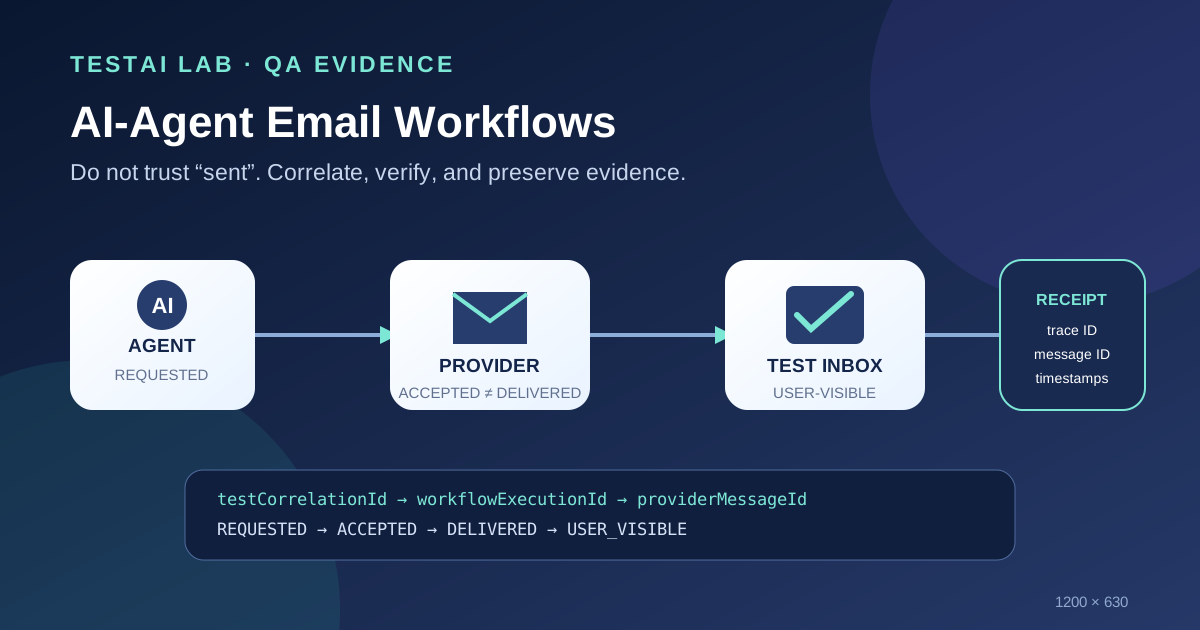
Even when the response is generated after an API acknowledgment, it usually proves only what that acknowledgment states—often acceptance for processing, not final delivery or mailbox visibility. It therefore cannot be treated as proof of delivery without independent evidence. A robust QA strategy therefore requires an independent receipt that can be correlated with the agent’s request and verified against the email service provider (ESP) or a controlled test inbox.
2. The Evidence Receipt – A Structured Test Artifact
A receipt is a lightweight, immutable record that ties together everything a tester needs to prove that a particular workflow execution behaved as expected, without leaking personal data. The recommended fields are:
| Field | Purpose | Example |
|---|---|---|
| testCorrelationId | Unique identifier generated by the test harness; used to correlate logs, traces, and provider data. | qa‑run‑20231012‑001 |
| workflowExecutionId | Identifier supplied by the workflow engine (e.g., n8n, Azure Logic Apps). | n8n‑exec‑5f3c9a |
| providerMessageId | ESP‑assigned ID returned after the provider accepts the message. | SG.1a2b3c4d5e |
| redactedRecipient | Recipient address with local‑part masked to protect privacy. | j***@example.com |
| templateVersion | Version or hash of the email template used. | v2.1‑hash‑d4e5f6 |
| requestTimestamp | When the agent issued the send request (ISO‑8601). | 2023‑10‑12T14:23:07Z |
| providerAcceptedTimestamp | When the ESP confirmed acceptance. | 2023‑10‑12T14:23:08Z |
| deliveryTimestamp | When the ESP reports final delivery (or bounce). May be absent in negative cases. | 2023‑10‑12T14:23:15Z |
| outcome | Enumerated result: REQUESTED, ACCEPTED, DELIVERED, BOUNCED, RETRY, FAILED, DUPLICATE_IGNORED. | DELIVERED |
The receipt can be emitted as a JSON file, stored in a test‑artifact repository, or attached to a CI job’s metadata. Keeping the receipt minimal and redacting recipient data reduces exposure, but privacy and retention requirements still depend on the organization, jurisdiction, and data classification.
3. Independent Verification Strategies
3.1 Query the Email Provider
Most ESPs expose an API to retrieve the status of a message by its providerMessageId. The test harness should:
- Poll the provider after a configurable back‑off (e.g., 5 s, 15 s, 30 s).
- Map the provider’s status codes to the receipt’s
outcomeenum. - Fail the test if the final status diverges from the expected outcome.
OpenTelemetry spans can carry attributes that correlate operations across services. Teams may record a provider message identifier as a carefully reviewed custom attribute, provided that it contains no sensitive message content and follows their telemetry governance rules.
3.2 Controlled Test Inbox
Create a dedicated mailbox (e.g., qa‑test@example.com) that is owned by the testing team. Using IMAP/POP or a provider‑specific “inbox API”, the test can:
- Search for a message using a test correlation value placed in a dedicated header or other controlled metadata. Do not assume that the provider’s API identifier is identical to the RFC
Message-IDheader; store both values when the provider exposes them. - Verify that the subject and template version appear as expected (without exposing the full body).
- Confirm that mailbox evidence and the provider timeline are consistent within an explicitly defined tolerance.
Because the inbox is under test control, it provides a user‑visible confirmation that the email reached a real mailbox.
3.3 Negative & Retry Scenarios
| Scenario | Test Setup | Expected Receipt Outcome |
|---|---|---|
| Invalid recipient format | Use bad‑email@@example..com | FAILED at request validation; no providerMessageId. |
| Provider throttling (429) | Simulate rate‑limit via mock or sandbox | RETRY with exponential back‑off; final outcome ACCEPTED or FAILED. |
| Bounce (hard) | Send to nonexistent@invalid.tld | BOUNCED after provider reports permanent failure. |
| Duplicate suppression | Send same testCorrelationId twice | Second execution should be idempotent; receipt shows DUPLICATE_IGNORED. |
These cases must be encoded as separate test cases, each producing its own receipt.
4. Idempotency and Duplicate Protection
AI‑agents often receive the same request multiple times (e.g., due to network retries). To avoid duplicate emails:
- Deduplication key – Use the
testCorrelationIdas a deterministic key stored in a durable cache (Redis, Azure Table, etc.). - Check‑before‑send – The agent queries the cache; if a record exists, it returns the existing
providerMessageIdwithout re‑sending. - Receipt reflects – The receipt’s
outcomeshould beDUPLICATE_IGNOREDwhen the cache hit occurs.
Testing this behavior requires two consecutive runs with the same correlation ID and verification that only one providerMessageId appears in the provider logs.
5. Privacy‑Safe Logging
When logging the workflow, follow these guidelines:
- Redact the local part of email addresses (
j***@example.com). - Log only the identifiers needed for testing (for example, correlation ID and provider message ID) and the relevant state transitions; first confirm that these identifiers are not treated as sensitive by the provider or your organization.
- Use structured logging (JSON) so that CI pipelines can parse and assert on fields.
OpenTelemetry trace attributes can carry approved correlation values. Redaction, attribute allowlists, access controls, and retention rules are still required because telemetry pipelines can expose data if they are configured carelessly.
6. CI Quality Gates
Integrate receipt validation into the CI pipeline:
| Gate | Check | Failure Condition |
|---|---|---|
| Trace correlation | Verify that a span with testCorrelationId exists and contains providerMessageId. | Missing span or mismatched IDs. |
| Provider acceptance | Ensure providerAcceptedTimestamp is present. | No acceptance within timeout. |
| Delivery verification | If the test case expects a real inbox, assert that the inbox contains a matching message. | Inbox search returns none. |
| Outcome consistency | Compare the receipt’s outcome with the test’s expected enum. | Mismatch. |
| Idempotency | For duplicate runs, assert that only one providerMessageId is generated. | Two distinct IDs. |
These gates can be expressed as contract tests (e.g., using Pact or a custom JSON schema) that run automatically on each pull request.
7. State Model – From Request to User Visibility
A clear state diagram helps both developers and testers reason about what can be asserted at each point.
REQUESTED  →  ACCEPTED_BY_PROVIDER  →  DELIVERED  →  USER_VISIBLE
   │                │                     │               │
   ▼                ▼                     ▼               ▼
validation provider ACK ESP status inbox receipt- REQUESTED – The agent has built the payload and issued the API call.
- ACCEPTED_BY_PROVIDER – ESP returns a
messageId; the receipt recordsproviderAcceptedTimestamp. - DELIVERED – ESP reports successful delivery; a permanent delivery failure is recorded separately as
BOUNCED. - USER_VISIBLE – The email appears in the recipient’s mailbox; only observable via a controlled inbox.
The required success state must come from the acceptance criteria. A test that promises delivery must not pass at ACCEPTED_BY_PROVIDER; a test scoped only to provider acceptance may stop there, while a user-visible test must also verify the controlled inbox.
8. Property‑Based / Contract‑Style Evidence Checklist
Below is a concise checklist that can be encoded as a JSON schema or a set of assertions in a test framework.
{
  "testCorrelationId": "string",
  "workflowExecutionId": "string",
  "providerMessageId": "string?",
  "redactedRecipient": "string",
  "templateVersion": "string",
  "requestTimestamp": "date-time",
  "providerAcceptedTimestamp": "date-time?",
  "deliveryTimestamp": "date-time?",
  "outcome": "enum[REQUESTED, ACCEPTED, DELIVERED, BOUNCED, RETRY, FAILED, DUPLICATE_IGNORED]"
}
Assertions to enforce:
requestTimestamp≤providerAcceptedTimestamp≤deliveryTimestamp(if present).- If
outcomeisDELIVERED,deliveryTimestampmust be present and the inbox must contain a matching message. providerMessageIdis required for any outcome other thanFAILEDat request validation.redactedRecipientmust match the pattern^[a-z]\*{2,}@.+$.- For idempotent runs, a second receipt with the same
testCorrelationIdmust haveoutcome = DUPLICATE_IGNOREDand no newproviderMessageId.
9. Where Automation Helps
| Area | Manual effort saved | Typical automation |
|---|---|---|
| Correlation ID injection | Writing unique IDs per test | Test harness generates UUIDs automatically. |
| Provider status polling | Repeated API calls, timing calculations | A reusable library that abstracts back‑off and maps ESP codes to outcome. |
| Inbox verification | Opening mail clients, searching messages | IMAP/REST client script that searches by Message‑ID header. |
| Receipt generation & storage | Copy‑pasting JSON snippets | CI step that writes a JSON receipt to an artifact store. |
| CI gate evaluation | Manual log inspection | Pipeline stage that validates the receipt against the schema and fails on mismatch. |
Automation should not replace human judgment about edge cases (e.g., interpreting a soft bounce that requires business‑level escalation). Instead, it provides fast, repeatable feedback while keeping the final decision in the hands of the QA engineer.
10. Conclusion
Testing AI‑agent email workflows demands evidence that goes beyond the agent’s own “sent” flag. By emitting a structured receipt, correlating it with OpenTelemetry traces, and independently confirming provider acceptance and actual mailbox delivery, teams gain a privacy‑safe, auditable artifact that can be enforced through CI quality gates. The checklist and state model presented here give QA engineers a concrete contract to verify, while automation handles the repetitive plumbing. The result is a test suite that reliably distinguishes between “the agent thinks it sent” and “the email truly arrived,” reducing false confidence and supporting robust, production‑grade AI‑driven communications.
Review Questions
- Why is the AI‑agent’s success response insufficient as the sole proof of email delivery?
- List the mandatory fields of the evidence receipt and explain the role of
providerMessageId. - How can a controlled test inbox be used to verify the USER_VISIBLE state?
- What steps should a CI pipeline take to enforce the receipt contract before marking a build as passed?
- Describe a test scenario that validates idempotent handling of duplicate email requests.
Sources
- OpenTelemetry Traces concepts – https://opentelemetry.io/docs/concepts/signals/traces/
- RFC 5322 – Internet Message Format – https://rfc-editor.org/rfc/rfc5322
- RFC 3464 – Delivery Status Notifications – https://rfc-editor.org/rfc/rfc3464
- n8n execution data documentation – https://docs.n8n.io/workflows/executions/
- Microsoft Learn: Monitor Azure Logic Apps – https://learn.microsoft.com/en-us/azure/logic-apps/monitor-workflows-collect-diagnostic-data
All cited sources are official. Provider-specific delivery states and identifiers must still be verified against the documentation for the email service used by the system under test.
Leave a comment
Share your thoughts about the article. No account is required.
Comments
Loading comments…